PromptCanvas: Composable Prompting for Exploration & Iteration
Most of us work with AI writing tools the same way: type a prompt, read the reply, rewrite the prompt, repeat. It works, but it's linear. Earlier instructions get buried in the chat history, and trying out alternatives means retyping and starting over. For creative writing, where most of the work is exploring, that's a poor fit.
PromptCanvas is a different take on that interface. It started as my bachelor thesis at LMU Munich and grew into two publications with Rifat Mehreen Amin, Daniel Buschek and Andreas Butz. My primary contribution was leading the design process, designing the UI, building the application and running the user studies.
What it is
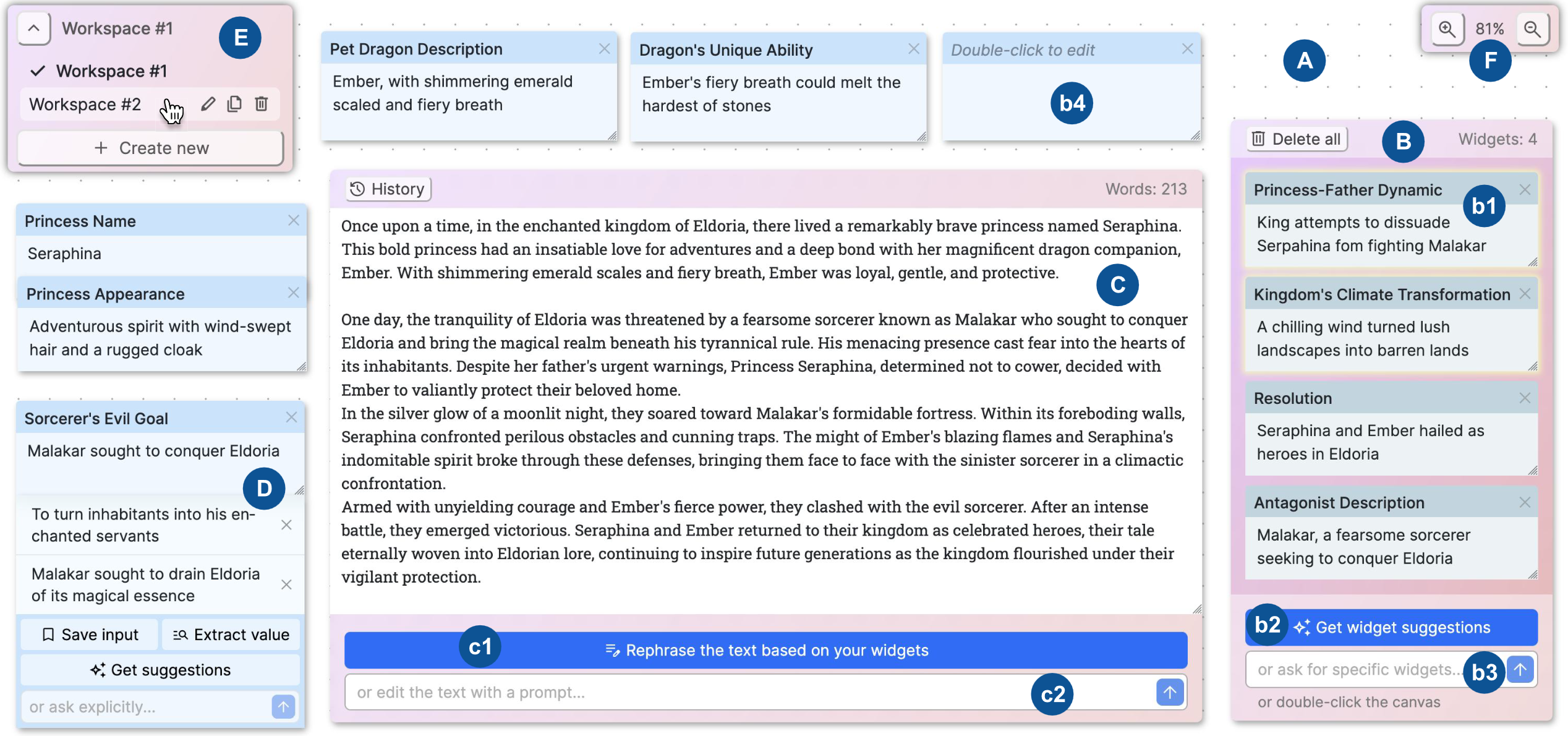
PromptCanvas lets you describe what you want as widgets on an infinite canvas next to your text. Rather than telling the model what to do, each widget declares one property the text should have, such as tone: melancholic, protagonist: a retired lighthouse keeper or length: ~200 words.
You can create widgets in three ways:
- ask the system to suggest widgets based on your draft
- prompt for a set of widgets on a specified theme
- double-click the canvas and make one yourself
Each widget comes with suggested values and alternatives, so you can try a new direction with one click instead of starting over or growing a long chat history. Widgets stay on the canvas, each holding its aspect independently. You can move, group or tweak them, then apply any combination to your text with one click. Over time the canvas becomes a personalized toolkit for the task.
Why we built it
Chat interfaces treat prompts as throwaway text. We wanted to design prompts as persistent, manipulable interface objects, each declaring its own aspect of your intent. The interaction should be non-linear: you can adjust any aspect at any time and explore multiple variants without losing context or starting over. Splitting an intent into modular parts should make it easier to break a task down, compare variations and stay in control of where the text goes.
What we found
We ran two lab studies with 18 participants each, plus a two-week field study with 10 participants:
- More creativity support: PromptCanvas scored clearly higher on the Creativity Support Index than a standard chat UI (82 vs. 62) and than Google's Wordcraft, an established AI writing tool (83 vs. 56).
- Strong preference: 89% of participants preferred PromptCanvas in both comparisons.
- More control, no extra workload: Participants felt more in control of the generated text. Workload was about the same as the baseline, and against Wordcraft they rated their own performance higher.
- High usability: On the System Usability Scale, PromptCanvas scored 85 compared to 71 for Wordcraft, and 86.5 in the field study. That puts it in the "excellent" range, well above the average benchmark of 68.
- Different ways of working: Each participant built a different layout and developed a personalized workflow. People explored ideas they said they wouldn't have thought of otherwise. In the field study, some even used it for programming.
There are still open problems. As widgets pile up, the canvas gets cluttered, and the model can struggle to satisfy many constraints at once. Setting up widgets also isn't worth it for quick, one-off tasks. Grouping widgets, scoping them to parts of the text and linking related widgets are good next steps.
Read more
The work is published in two papers. The CHI short paper presents the first version of PromptCanvas and the initial lab study comparing it to a chat interface. The TiiS journal paper covers the refined system, a second lab study against Google's Wordcraft, the two-week field study and a much more detailed analysis.
ACM Transactions on Interactive Intelligent Systems (TiiS) 2026, full paper: PromptCanvas: Composable Prompting Workspaces Using Dynamic Widgets for Exploration and Iteration in Creative Writing (doi.org/10.1145/3817049)
ACM Conference on Human Factors in Computing Systems (CHI) 2025, Late-Breaking Work: Composable Prompting Workspaces for Creative Writing: Exploration and Iteration Using Dynamic Widgets (doi.org/10.1145/3706599.3720243)
We're currently preparing to release the source code on GitHub. In the meantime, feel free to reach out if you have questions, ideas or would like to build on the work.